The Enhanced Games and Masters Swimming: What Are We Really Chasing?
The Enhanced Games have entered the sporting conversation, with their one afternoon of racing in Las Vegas.
Legal performance-enhancing drugs. Million-dollar bonuses. Silicon Valley investment. Open enhancement. The meet’s most talked-about performance was Kristian Gkolomeev’s chemically assisted 20.81 in the 50m freestyle, a swim that sits outside Cam McEvoy’s 20.88 World Record.
It is provocative by design, and perhaps that is why it has captured so much attention so quickly.
The argument from the organisers is simple. Elite sport has never been entirely clean, anti-doping systems are imperfect, and athletes are already using every possible advantage through technology, recovery science, nutrition and training innovation. So why not stop pretending? Why not regulate enhancement openly and honestly?
It is a seductive argument because it taps into something deeply human. We have always been fascinated by limits. Citius, Altius, Fortius - Faster, Higher, Stronger.
For more than a century, those words have represented the ideal of sporting excellence at the Olympics through human endeavour, discipline and courage. The Enhanced Games challenge that ideal directly by asking whether sporting greatness should still have boundaries at all.
Sport itself has always been built on the pursuit of improvement and optimisation. Modern athletes already operate inside highly engineered systems involving biomechanics, altitude training, lactate testing, recovery protocols and sports science support teams.
So where exactly is the line? That is the uncomfortable question sitting underneath this entire debate. Are the Enhanced Games really just a marketing tool to sell PED’s to older athletes chasing lost youth? Are Masters athletes their prime target?
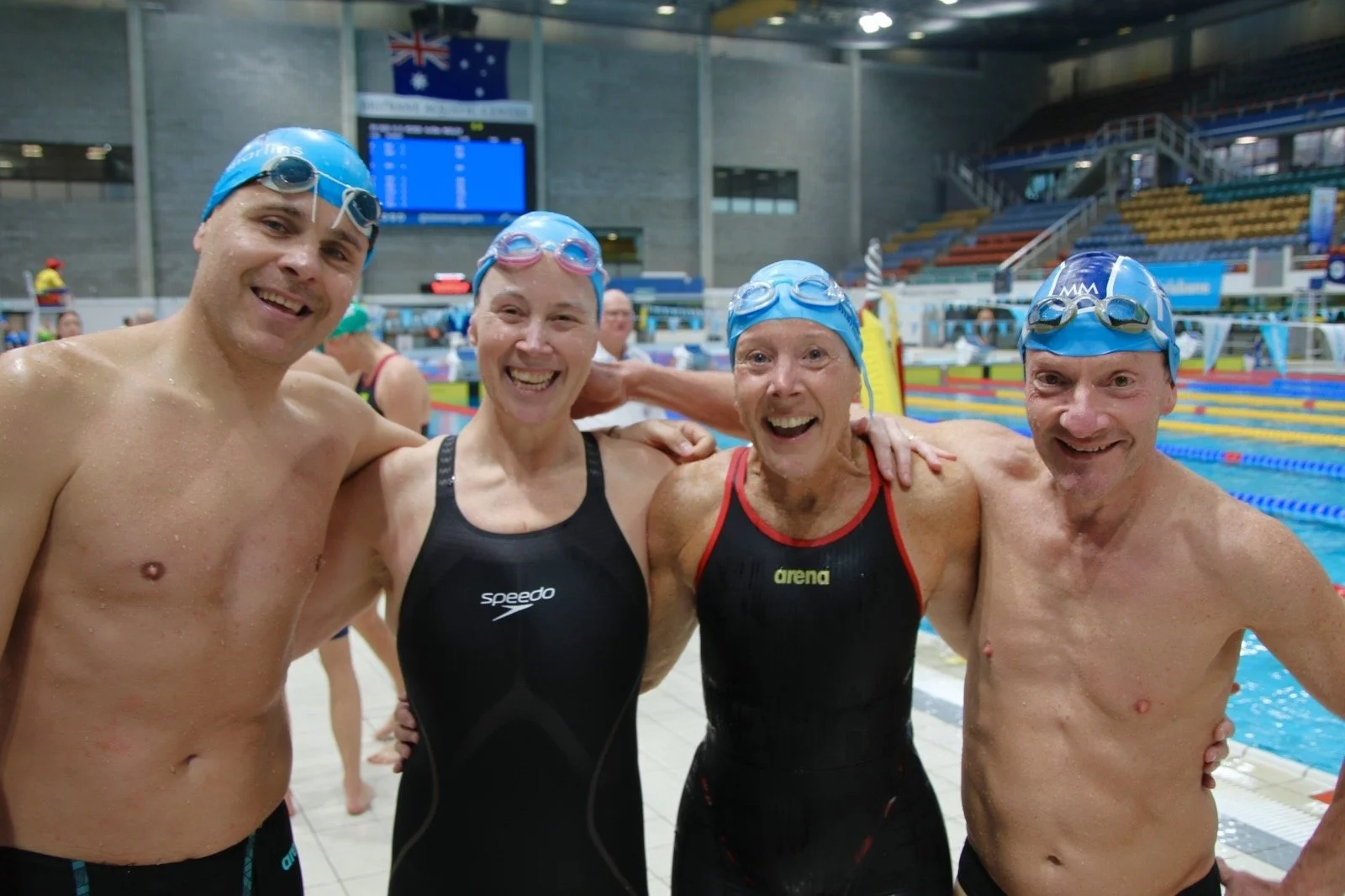
But from my perspective, I think the conversation feels different. Masters swimming has never really been about chasing perfection. It is about resilience. It is about adaptation. It is about continuing to strive while fully understanding that ageing is real and unavoidable.
Every Masters swimmer knows this truth intimately. Recovery takes longer. Shoulders tighten. Sleep matters more. Strength becomes harder earned. Some days the body simply does not respond the way it once did. You can train brilliantly and still be slower than you were twenty years ago.
And somehow that is exactly what makes Masters swimming meaningful.
In Masters swimming, success is rarely linear. Sometimes the victory is a PB. Sometimes it is returning after injury. Sometimes it is simply finding the courage to stand behind the blocks again after a disappointing swim, a difficult year or a changing body. That perspective gives Masters athletes a very different relationship with performance than elite sport often promotes.
One of the strongest critiques of the Enhanced Games came from author and coach Steve Magness, who wrote that sport is ultimately about “coming face to face with your own limits”. That line speaks to me, because we now live in a culture increasingly obsessed with optimisation. Everything is about shortcuts, hacks, enhancement and endless improvement. We filter our faces, track our sleep, monitor our stress, analyse our data and look for ways to accelerate every process of human existence.
Sport remains one of the few places where reality still refuses to negotiate. You can train perfectly and still lose. You can prepare brilliantly and still fall short. You can desperately want a result and still not achieve it. That is not a flaw in sport. That is the point of sport.
As Masters swimmers, we understand this better than most. Standing behind the blocks in your fifties, sixties or seventies already requires a kind of honesty. Nobody is pretending the body is the same as it was at twenty-two. Masters swimmers learn to negotiate with ageing rather than deny it completely. The achievement is not in defeating time altogether. It is in continuing to engage with the process despite time. That is profoundly human.
The Enhanced Games conversation also lands differently in Masters sport because the emotional pressure points are very real. Many older athletes struggle quietly with changing bodies, slowing times and the loss of former performance. Modern wellness culture increasingly sells the idea that decline itself is optional if only you find the right supplement, clinic, hormone protocol or enhancement strategy.
And this is where things become murky. There is obviously a legitimate place for medical treatment and health interventions. But sport changes fundamentally once enhancement shifts from therapy into expectation. Once enhanced performance becomes normalised, clean athletes are no longer making entirely free choices. They are choosing between their values and their competitiveness. That alters the moral structure of sport completely.
Masters swimming has traditionally been one of the purest expressions of lifelong sport. People race because they love the process, the community and the challenge of personal improvement. If enhancement becomes culturally normalised, even informally, that changes the emotional fabric of Masters sport itself. Comparisons become clouded. Trust erodes. The focus subtly shifts from training and resilience towards intervention and optimisation.
At the same time, the early results from the Enhanced Games revealed something interesting. Several unenhanced athletes still defeated enhanced competitors. It was a reminder that drugs are not magic. Talent, skill, race intelligence, technique and years of work still matter enormously. Even the most publicised swims from the meet generated more intellectual discussion than emotional connection. People were impressed, but not necessarily moved. And perhaps that is because sport has never really been only about times or records.
People connect to stories. To struggle. To setbacks. To perseverance. To watching another human being push themselves honestly against limitation. That is why athletes like Cameron McEvoy resonate so deeply. Not simply because of the stopwatch, but because people understand the journey behind it.
In many ways, the Enhanced Games may accidentally strengthen the appeal of Masters swimming and community sport. The more engineered elite sport becomes, the more people may crave something authentic again. Ordinary people balancing work, family, stress, injuries and ageing while still chasing improvement. Not perfection. Not immortality. Just honest effort. And perhaps that is the real question sitting underneath this entire debate.
If sport becomes entirely about engineered outcomes, what happens to the humanity that made sport worth watching in the first place?